

Printed from lightingforgardens.com - come back to order online or email your queries to sales@lightingforgardens.com
Welcome back (Not you? Click here)
"Thanks for the super-efficient despatch of this and our previous order...Your company is a pleasure to deal with...”
P B, Bristol
“Goods received and installed. Very pleased, a really excellent product
B H, Sheffield
“Excellent spotlights, very solid and well fabricated. Thank you for your superior service”
C-H H, Sweden
12 volt MR16 reflector lamps are 50mm in diameter and fit most low voltage outdoor spotlights, recessed uplights, downlights, recessed steplights and underwater lights except miniature garden lighting fittings such as the Microspot miniature spotlights and downlights which use the smaller MR11 35mm lamp. Claimed average lamp life is 3000-4000 hours, which should be halved for conditions of use in outdoor lighting; 1000 hours is about the same as having your garden lighting on every night of the year for about 3 hours, so lamp life in most domestic gardens means you won’t be changing quality lamps more often than every 1-2 years on average. Make sure you use a quality branded lamp such as BLV or GE as many lamps imported from the far east, especially "retail own brand" lamps won’t last anywhere near as long.
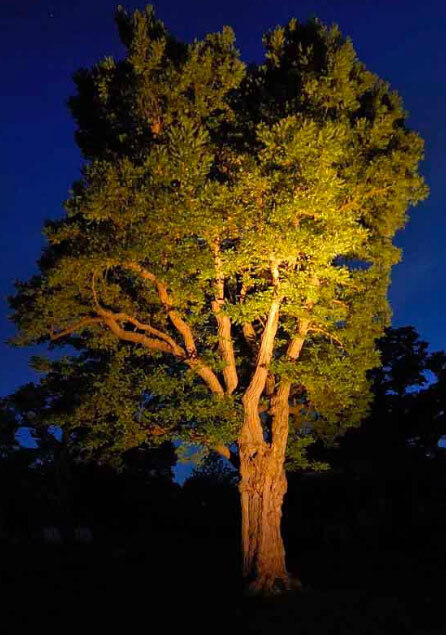
Choosing lamps (bulbs) for any type of exterior spotlight, uplight or downlight which uses a low voltage MR16 halogen spotlight lamp is partly a question of brightness and partly one of correct beam angle. The beam angles are 12, 24, 36 and 60 degrees. Sometimes you will want a small pool of light from a narrow beam to accent a feature without lighting the surroundings; other garden lighting subjects, such as lighting diagonally across shrub borders, will require the widest coverage available, such as a 60° beam. For example, a 60° beam will provide wide coverage from a pergola beam only 1.5 metres above a table below, but if you are uplighting a slender tree the coverage of a 60° beam will be wasted in the night sky; a narrower beam will “fit” the shape of the tree more closely. The widest beam angle available in MR11 lamps is 36°.
Energy consumption is increasingly a factor in choosing garden lighting: The new generation of Powersaver 12 volt MR16 halogen lamps now provides increased efficiency compared to standard MR16 halogen reflector lamps. A 50w Powersaver now does the same job as a 75w standard MR16 halogen lamp and a 35w Powersaver now does the same job as a 50w standard MR16 halogen lamp: this means 50w spotlights can now be used instead of 75w MR16 spotlights for tree uplighting applications.
Brightness isn’t just about the wattage of the lamp. The brightness of a 20 watt lamp squeezed into a narrow spot beam can produce a brighter pool of light than that of a 50 watt lamp projected in a wide flood beam. So, first “fit” the beam angle to your subject, then think about brightness. The diameter of the beam can be read from the table below to select the correct beam angle lamp if you want to fit a circle of light precisely to a subject, such as a wall plaque or wall fountain. For example, if you are using spike mount spotlights to illuminate a border between 2 and 3 metres deep and containing shrubs up to 2 metres high, a 60o beam will give you between 2.3 and 3.5 metres of coverage, which gives a suggested spacing between spotlights in the border.
| Lamp wattage | MR16 tungsten halogen reflector lamps: Typical Applications | |||
|---|---|---|---|---|
| 10 watts | - | Crosslighting steps | - | - |
| 20 watts | Uplighting/downlighting columns; Spotlighting small features |
Uplighting pergola piers; Accent lighting small features; Uplighting/downlighting columns |
Plant lighting in small gardens; Accent lighting close features; Crosslighting steps |
Plant lighting in small gardens; Moonlighting from small trees; Downlighting onto tables |
| 35 watts | Uplighting tall columns; Spotlighting small features |
Uplighting small slender trees; Accent lighting small features |
Shrub lighting in new gardens; Downlighting from houses; Accent lighting larger features |
Shrub lighting in new gardens; Moonlighting from trees; Downlighting onto tables |
| 50 watts (or 35w Powersaver) | Spotlighting from a distance; Uplighting columnar trees |
Uplighting slender trees; Spotlighting from a distance |
Grazing house facades; Accent lighting larger features; Uplighting small trees |
Crosslighting mature shrubs; Uplighting small spreading trees; Wall washing |
| 75 watts (or 50w Powersaver) | Uplighting columnar trees | Uplighting slender trees | Uplighting fan-shaped trees | Uplighting spreading trees |
The applications table above gives some general guidelines on application of various beam angles in a garden lighting scheme. The result will vary for a number of reasons;
| Comparison of MR16 50w tungsten halogen reflector lamps: beam spread coverage and brightness | ||||||||||||
|---|---|---|---|---|---|---|---|---|---|---|---|---|
| Lamp: | 12 Degrees | 24 Degrees | 36 Degrees | 60 Degrees | ||||||||
| Beam: | Narrow spot beam | Spot beam | Flood beam | Very wide flood beam | ||||||||
| Beam Diameter (Metres) |
Distance from lamp (Metres) |
Light level (lux) for 50w lamp |
Beam Diameter (Metres) |
Distance from lamp (Metres) |
Light level (lux) for 50w lamp |
Beam Diameter (Metres) |
Distance from lamp (Metres) |
Light level (lux) for 50w lamp |
Beam Diameter (Metres) |
Distance from lamp (Metres) |
Light level (lux) for 50w lamp |
|
| 0.21 | 1 | 11000 | 0.43 | 1 | 3600 | 0.65 | 1 | 2000 | 1.15 | 1 | 850 | |
| 0.42 | 2 | 2750 | 0.85 | 2 | 900 | 1.31 | 2 | 500 | 2.31 | 2 | 212 | |
| 0.64 | 3 | 1222 | 1.28 | 3 | 400 | 1.95 | 3 | 222 | 3.46 | 3 | 94 | |
| 0.85 | 4 | 688 | 1.71 | 4 | 225 | 2.61 | 4 | 125 | 4.62 | 4 | 53 | |
| 1.06 | 5 | 440 | 2.13 | 5 | 144 | 3.25 | 5 | 80 | 5.76 | 5 | 34 | |
| 1.28 | 6 | 305 | 2.56 | 6 | 100 | 3.91 | 6 | 55 | 6.92 | 6 | 23 | |
| 1.47 | 7 | 224 | 2.98 | 7 | 73 | 4.55 | 7 | 40 | 8.08 | 7 | 17 | |
| 1.71 | 8 | 171 | 3.41 | 8 | 56 | 5.21 | 8 | 31 | 9.24 | 8 | 13 | |
The comparison table above includes the light level (lux) achieved by 50 watt lamps at each beam angle, so you can see how brightness reduces with distance from the lamp and as the lamp beam is spread wider. Be prepared to experiment to get the right result. For example, when calculating transformer ratings, allow 50 watts per fitting even if you think 35 watt lamps will suit your newly planted shrub border best to begin with; if you think a 20 watt lamp over the table will be bright enough, allow a little spare capacity in the transformer in case your partner thinks you should have fitted a 35 watt lamp instead (or maybe fit a narrower beam to get a smaller but brighter pool of light!).
Copyright 2010; Information based on products supplied by Lighting for Gardens Limited and is advisory only. The company accepts no responsibility for incorrect use or application of information given. Light fittings can become hot in use; exercise appropriate precautions. Exterior electrical installations should be undertaken by a qualified electrician.