
There comes a point in most gardens when the furniture is in place, the planting has started to settle, and the patio is doing exactly what it was intended to do. Then the sun goes down.
It's often at that moment that homeowners realise how little thought they've given to garden lighting.
Good garden lighting isn't really about making a garden bright. It's about making it usable. And when it comes to outdoor dining, that's especially important. You want enough light to enjoy a meal, see the faces around the table, and move around safely, without feeling as though you're sitting under a floodlight.
The best outdoor dining spaces tend to use several layers of light rather than one dominant fitting. A warm wall light on the house might provide the general illumination, while a few carefully positioned lights around the garden add depth and interest.
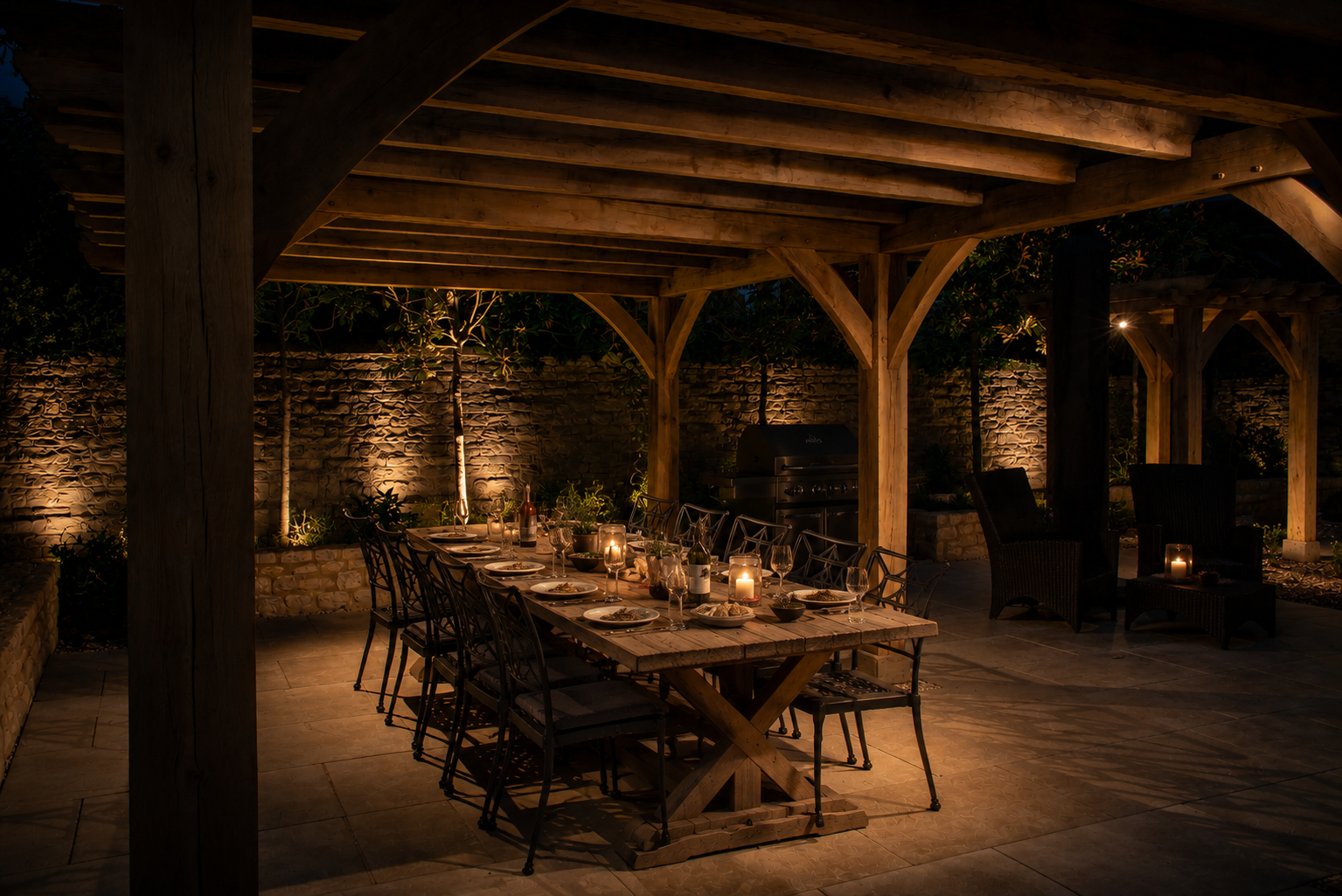
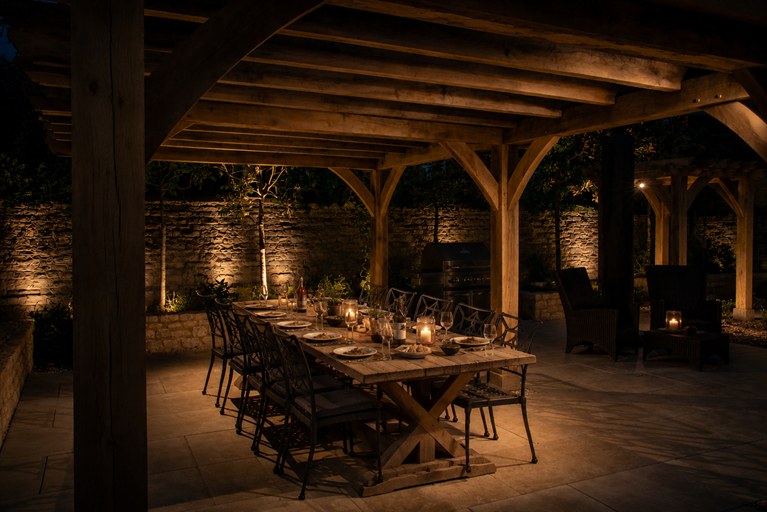
One of the simplest and most effective approaches is to create a sense of enclosure around the dining area. A pergola, for example, becomes much more inviting when fitted with discreet downlights or a string of warm festoon lights overhead. The light doesn't need to be particularly bright. In fact, most outdoor lighting schemes benefit from a little restraint.
A mistake we see quite regularly is trying to light the entire garden from the dining table. The result is usually disappointing. The eye is naturally drawn to contrast, so it's often more effective to leave parts of the garden in shadow and highlight just a few key features. A mature tree, an attractive shrub border, or an ornamental grass planting can all become focal points after dark with the addition of a small spotlight.
Another consideration is the dining table itself. People tend to focus on surrounding lighting and forget the practicalities of eating outdoors. If guests are struggling to see what's on their plate, the atmosphere quickly loses its charm. A pendant suspended beneath a covered structure, or a rechargeable table lamp placed centrally, can often provide all the task lighting that's required.
Pathways and steps deserve attention too. Outdoor dining inevitably involves people moving around the garden, carrying food, drinks, and occasionally navigating unfamiliar routes after sunset. Low-level path lights or deck lights can make a significant difference without drawing attention to themselves.
Colour temperature is another area where simplicity usually wins. Warm white lighting creates a far more welcoming environment than cooler alternatives. It complements planting, flatters people, and generally feels more comfortable for social spaces.
Finally, don't underestimate the value of quality fittings. Garden lighting is exposed to weather throughout the year, and outdoor dining areas are often used most heavily during the months when conditions can be unpredictable. Choosing well-made fittings with suitable IP ratings will usually save money and frustration in the long term.
The most successful outdoor dining spaces aren't necessarily the brightest or the most elaborate. They're the ones where the lighting feels natural, comfortable and almost unnoticed. When guests stay longer than planned and nobody is in a hurry to go inside, that's usually a sign you've got it right.